

- 15-minute read
Self-employed or Limited Company: when is the right time to make the transition
- Published by Yaiza Rodríguez
- 21 Jul 2026
Should I remain self-employed or take the step towards a Limited Company (SL)?
This decision does not only affect your taxation and personal liability, but also how your business opportunities grow and the image you project to clients, suppliers, and potential investors.
Identifying the right time to make the change can help you grow with greater confidence and make more informed decisions for the future of your business.
Important note
If the service is provided personally by you (lawyer, doctor, consultant, architect, etc.), it is especially important that the company has a real organisation and business activity consistent with the chosen legal structure.
The decision to operate as an individual or through a company should be based on a genuine and coherent business organisation and activity that aligns with the chosen structure.
The company must carry out a real business activity and not simply act as a “shell” created solely to reduce taxes.
01. Self-employed: the simplest way to get started
Starting as a self-employed professional remains the simplest way to start a business: administrative requirements are minimal, initial costs are lower, and day-to-day management is relatively straightforward. You are taxed through Personal Income Tax (IRPF), a progressive tax system where the rate increases as your income rises.
At the beginning, this approach often works very well, especially if your profits are not particularly high or your income is irregular. However, as your business grows, two key challenges arise: taxation and personal liability.
a) Progressive taxation
Personal Income Tax (IRPF) is progressive, meaning that as your income increases, so does the percentage you pay in taxes.
In practice, this means that each additional client may generate a lower real profit than the first ones, because a larger proportion of your income goes towards taxes. Although your turnover increases, the amount that remains in your pocket does not grow at the same rate. This is something many self-employed professionals experience and can make growth feel “penalised”.
b) Personal liability
As a general rule, a sole proprietor is liable with their personal assets. There is a legal figure known as the Entrepreneur with Limited Liability (ERL), which allows liability to be limited under certain legal conditions and requirements, through registration with the Commercial Registry and the corresponding public record. This limitation does not apply in certain cases, including those related to tax debts and Social Security obligations, among others.
02. Limited Company: security and planning
A Limited Company (SL) is an entity with its own legal personality, meaning that your business is separate from you as an individual. This provides clear advantages in terms of liability, taxation, and growth opportunities.
a) Corporate Income Tax
An SL is subject to Corporate Income Tax, with a general tax rate of 25%, and reduced rates applying in certain cases (for example, newly incorporated companies or small businesses).
This means that, once a certain level of profits is reached, the company’s tax burden becomes more predictable and, in many cases, lower than continuing to be taxed entirely through Personal Income Tax (IRPF).
It is important to bear in mind that, in addition to the tax paid by the company, when you withdraw money from the company (through salary or dividends), you will also be taxed under your personal income tax.
b) Limited liability
In an SL, the company has its own legal personality and, as a general rule, liability falls on the company itself, separating personal assets from business assets. This separation is not absolute in every situation, so each case should be reviewed with a professional advisor.
2.1. Advantages os an Limited Company
- Better protection of your personal assets against business debts.
- Greater credibility with clients, suppliers, and investors, especially in B2B relationships and larger contracts.
- Easier entry of new shareholders and access to external financing.
- Ability to reinvest profits within the company efficiently over the medium term.
2.2. Practical considerations
Accounting: more formal, with additional obligations such as the legalisation of accounting books.
Administrative burden: greater than for a self-employed professional, with higher costs (advisory services, notary fees, registration fees), but it provides the structure needed to grow in a secure and sustainable way.
03. When is it usually advisable to move to a Limited Company
There is no single mandatory threshold, but there are certain indicators that many advisors use as a reference when considering the move to a Limited Company.
- Sustained annual net profits: it is often worth evaluating the move to a Limited Company when profit levels are high and consistent over time; the specific threshold depends on each situation and should be assessed with a professional advisor.
- Stable and recurring income, rather than occasional revenue: this makes tax planning easier and allows the business to take on higher fixed management costs.
- Need to reinvest profits: such as in a team, technology, premises, or other business assets.
- Hiring employees or delegating key tasks: having a company structure can provide better organisation for employment relationships and risk management.
- Projects with greater financial or legal risk (construction, consulting, certain professional services): protecting personal assets becomes essential.
- A strong professional image: necessary when working with large companies or public sector organisations.
Practical example:
A software developer who starts out working alone may remain self-employed. However, if they begin taking on larger projects, hiring employees, or attracting investors, a Limited Company can help protect their assets, build confidence, and manage growth in a more structured way.
04. Quick comparison table: Self-employed vs Limited Company
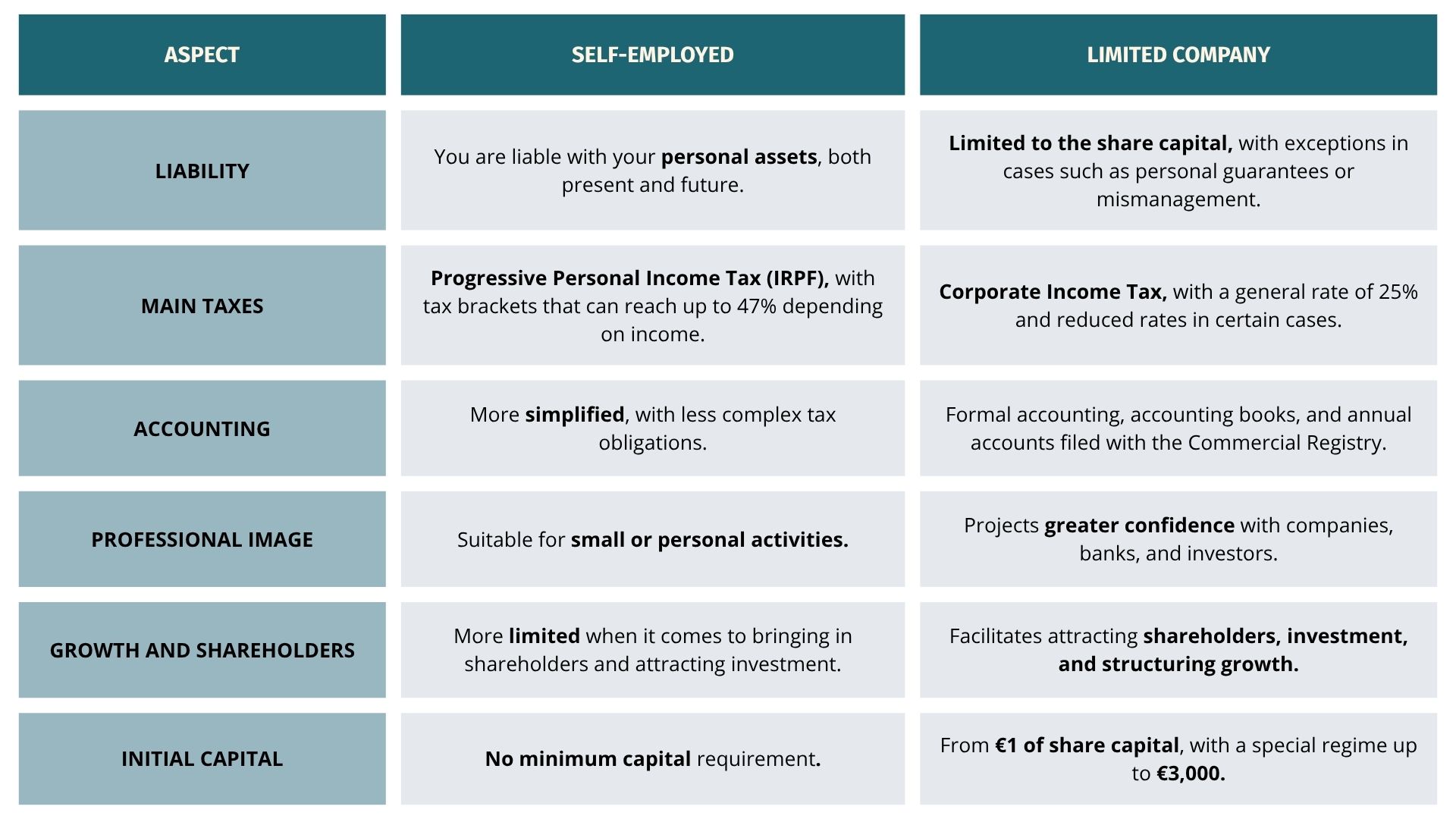
This table summarises why, as your business grows in terms of profits, risk, and ambition, a Limited Company can offer advantages that self-employment cannot provide.
05. Strategic factors and final advice
When making a decision, it is not enough to look only at the numbers. You should also consider your income volume, stability, risks, and future plans.
Before making the move:
- Evaluate your income, profits, and risks to determine whether the tax benefits and liability considerations justify the change.
- Think about the future of your business: if you plan to grow, hire a team, or attract investment, forming a limited company will give you greater opportunities for expansion.
- Do not delay the decision: if you already meet the criteria, waiting may mean paying more taxes and taking on more risk than necessary.
- Consult a tax or accounting advisor who can assess your specific situation and help you choose the right time and the best way to make the transition.
Contact us now and take the next step!